The Engine That Almost Killed Mazda — and Why It’s Still Alive Today
Key Points
- Mazda introduced the innovative Wankel rotary engine in the 1967 Cosmo Sport.
- Rotary engines were compact, smooth, but plagued by fuel inefficiency and emissions issues.
- Mazda revived the rotary as a battery generator in the 2023 MX-30 R-EV hybrid.
The internal combustion engine, for all its mechanical sophistication, still runs on a 19th-century mechanical idea: pistons rising and falling, a crankshaft spinning, a steam-age architecture repurposed for gasoline and diesel. Every engine from Henry Ford’s era right through to modern direct-injection and forced induction is fundamentally a variation on that same theme. So when a small Japanese company called Mazda introduced the Cosmo Sport in 1967, it wasn’t just a new car. It was introducing a genuinely new kind of engine, one that didn’t share a single conceptual bone with anything that had come before it.
The Triangle That Changed Everything
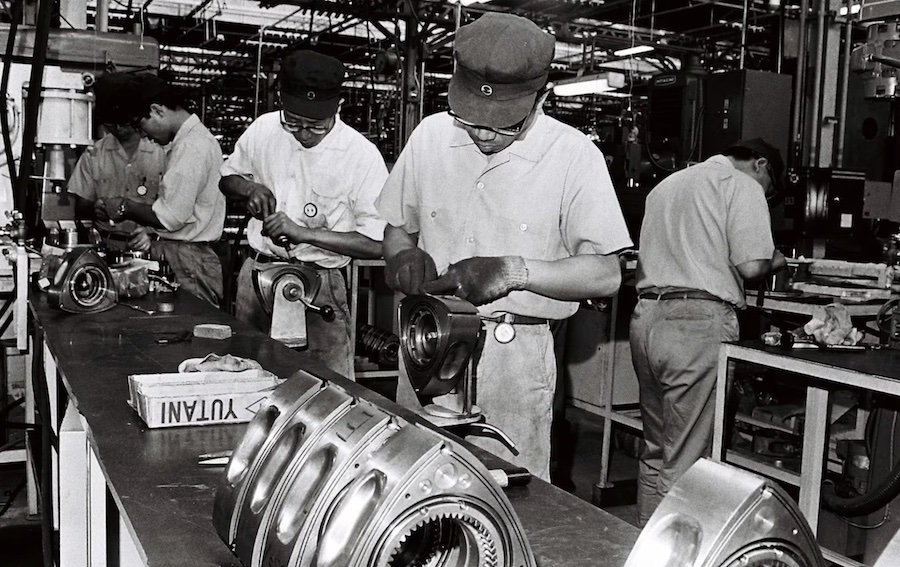
The engine in question was the Wankel rotary, named after German engineer Felix Wankel, who first patented the concept in 1929. Instead of pistons moving back and forth, the rotary engine used a triangular rotor spinning inside an oval combustion chamber. Its triangular shape allows intake, combustion, and exhaust to all happen in a single revolution of the rotor, making it more efficient than a comparable four-stroke piston engine, which delivers one power pulse every two revolutions. Compared to a conventional engine of equivalent output, the rotary is smaller, lighter, and, because it has no reciprocating parts, quieter and smoother as well.
Mazda didn’t invent the idea, but they were the ones with the stubbornness and engineering talent to actually make it work. Early prototypes suffered from “devil’s fingernails”, or chatter marks scratched into the housing by the tip seals vibrating at their natural frequency, as well as heavy oil consumption. Mazda’s engineers solved the seal problem by redesigning the apex seals’ resonance frequency, and addressed oil burning by adding a tiny amount of lubricant to the fuel mixture. It worked at the time. The resulting 982cc 10A engine in the Cosmo Sport produced 110 horsepower at 7,000 rpm and pushed the car to a top speed of 124 mph, genuinely impressive figures for 1967 and for an engine that displaced less than a liter.
A Brilliant Engine With One Very Expensive Flaw
Here’s where the story turns complicated. The same characteristics that made the rotary so simple also made it prone to poor sealing at the three rotor tips. And poor sealing meant one thing: unburned fuel slipping past into the exhaust. To address overheating at the rotor tips, Mazda added a tiny drop of oil to the fuel mixture for cooling, which sorted the thermal issues but caused emission problems that would plague the rotary engine throughout its entire lifespan.
Mazda was so fully committed to the Wankel that by 1974 it had all but eliminated piston engines from its products, a decision that nearly led to the company’s collapse when the oil crisis of the 1970s struck and fuel economy suddenly became the only number anyone cared about. The company survived, pulled back, and eventually confined the rotary to sports car duty in the RX-7 and later the RX-8. The RX-7 went on to sell over 810,000 units across its lifespan and became one of the most beloved sports cars of the 1990s. The RX-8, though, was the beginning of the end. Fuel consumption and exhaust emissions remained persistent sticking points throughout the engine’s life, and these were ultimately the reasons why the RX-8 went out of production in 2012.
The Rotary’s Unlikely Second Act
Mazda never quite let go. At the 2023 Brussels Motor Show, the company revealed the MX-30 R-EV, a series plug-in hybrid where the rotary engine serves not as a driver of the wheels but as a compact, near-vibration-free generator to recharge a battery. The new single-rotor 8C engine displaces 830cc, produces 74 horsepower, runs on direct gasoline injection at a high compression ratio of 11.9:1, and keeps CO2 output down to just 21 grams per kilometre under WLTP testing. In this role, freed from having to drive wheels and run across an enormous rev range, the rotary is actually close to ideal — compact, smooth, and perfectly happy spinning at a constant, efficient speed.
It is not the comeback rotary fans dream of. But it might be the smarter move, recognizing that the rotary’s greatest strength was never raw power output; it was the remarkable density of engineering packed into a space the size of a carry-on bag. A century after Wankel first sketched his triangular rotor, Mazda is still the only manufacturer in the world that never stopped believing in it.
