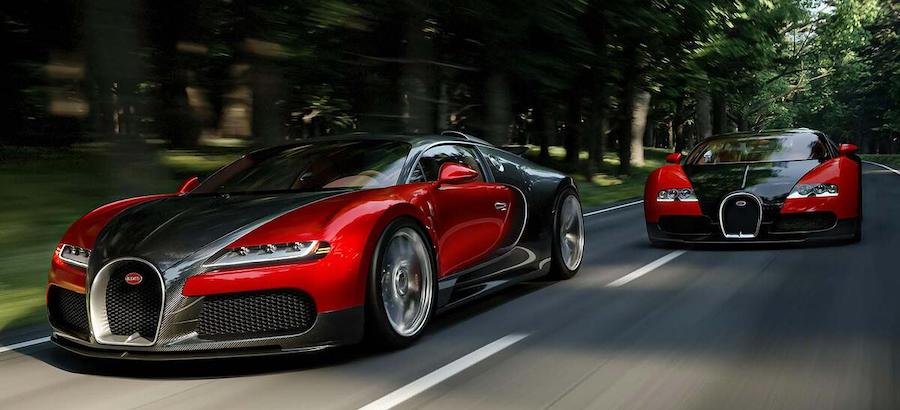
Now celebrating its 20th anniversary, the Veyron (and Herr Piëch) is the subject of the latest Bugatti Programme Solitaire build, commemorating the legendary executive and his brainchild with the French automaker's latest performance and design talents.
The F.K.P. Hommage takes its name from the initials of Piëch (middle name Karl), who first came up with the idea for the Veyron and its world-beating W16 engine on a bullet train in Japan. Piëch's engineering prowess had already been proved by his legendary VR6, a design principle that in turn gave birth to the W8 and W12 engines found in cars like the Volkswagen Passat and Bentley Continental GT.
But it would be the quad-turbocharged W16 engine – essentially two narrow-angle VR8 engines joined at the crankshaft – that would power the Veyron 16.4, giving it 987 horsepower at first before expanding to 1,183 hp in the Super Sport and Grand Sport Vitesse models.
That 8.0-liter engine lived on for nearly two decades, moving from the Veyron to its Chiron replacement, which made a healthy 1,479 hp on its debut. Heavy engineering updates over the years eventually led to the Bugatti Bolide's 1,825-horse version of the engine, although the F.K.P. Hommage instead uses the 1,580-hp state of tune from the Chiron Super Sport 300+. That mill was chosen for the Solitaire project because it was the first Bugatti to fulfill Piëch's hopes of creating a 300-mile-per-hour supercar. It's not immediately clear what car forms the basis of the Veyron tribute, but we suspect there's a Super Sport hiding under that voluptuous bodywork.
Classic Design With Modern Tech
And what a looker it is. The Veyron 16.4 was somewhat divisive when it launched, its supercar proportions somewhat at odds with the 1920s-style two-tone paint motif and Bauhaus exterior details. But time has been kind to the Veyron, and now, the F.K.P. Hommage wears its older sibling's clothes very well. The wider, more substantial dimensions of the Chiron lend themselves well to the drooping headlight shape and rearward stance of the 16.4, although the design has been refined here and there.
For starters, the color scheme makes the most of modern paint technology, with an aluminum-based coating sitting underneath a red-tinted clearcoat, giving the paint remarkable depth and luster. Instead of black paint, the rear portions of the bodywork are genuine exposed carbon fiber, with a 10 percent black pigment incorporated into the clear topcoat. The look is deeper and more interesting than plain old red and black, reflecting the 20 years of paintwork advances between the Veyron and the F.K.P. Hommage.
"It was a tremendous honor to work directly with the client on this project, refining every detail through multiple iterations to create what I consider the ideal, definitive Veyron."
- Frank Heyl, Bugatti Design Director
The reshaped, one-off body incorporates the car's two-tone color split a little better than the Veyron's, while larger 20- and 21-inch wheels retain the original's wagon-spoke design. A nicely integrated horseshoe grille was milled from a block of aluminum and dovetails slightly better into the front end. The F.K.P. Hommage also hangs onto the original car's gorgeous and distinctive roof-mounted air intakes just aft of the passenger cabin, which, by the way, might as well be a time warp back to 2006.
Instead of the Chiron's unusual cabin design with a strong central roof rib, the Veyron tribute is a copy-paste-skew version of the original's interior. Engine-turned aluminum trim lives on the center stack, while the console is rendered in brushed alloy. Like the Programme Solitaire Brouillard, fabric adorns the seats, although the ruddy brown color scheme and EB logos recall the very first Veyron ever sold. A sophisticated 41-millimeter Audemars Piguet Tourbillon timepiece sits high on the dashboard, its octagonal face and self-winding mechanism imparting some old-world class into the ultra-modern hypercar.
One Of One, With A Price To Match
It would be inappropriate for Bugatti to acknowledge how expensive each of its Programme Solitaire builds cost, but considering this is the only modernized "Veyron" in existence, it likely took its new owner several million bucks to make it happen. The F.K.P. Hommage is the second build from Bugatti's highly bespoke division, following up on the aforementioned Brouillard and again based on an existing W16 car's platform. That engine's era is over at Bugatti, as the Tourbillion supercar will instead feature a hybridized, naturally aspirated V16 engine.
As wonderful as the Tourbillon sounds, we'll miss the old W16's whooshing, earth-cracking engine note, and we're glad to see Piëch's wild idea getting its flowers two decades later.


Related News
