2027 Volkswagen Atlas Finally Has An Official Debut Date
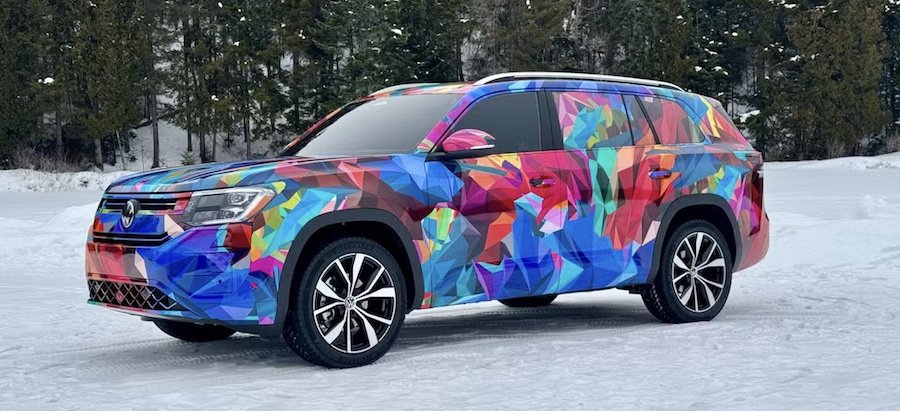
Media days for the show take place on April 1 and April 2 before opening up to the public on Friday, April 3 through Sunday, April 12. This is a huge reveal for Volkswagen, not only because the Atlas is physically the company's largest model sold in the United States (200.7 inches), but also because this vehicle (including Atlas Cross Sport) accounted for roughly a third of the company's sales in this market.
The 2027 Atlas is also a big deal because it represents the first full redesign since this nameplate was introduced in 2017. VW facelifted the Atlas for the 2021 model year, then once more for the 2024 model year, but 2027 will be an all-new second-generation.
New Generation, New Platform
This second-generation Atlas isn't just the old model with some new bumpers; every panel is new except for the roof. VW presented the car with a colorful camouflage wrap that attempts to hide some of the new details using the current headlight and taillight designs as well as wheels from the existing model. The wheelbase will remain the same, so you should expect similar exterior and interior dimensions.
Underneath, this vehicle rides on the MQB Evo platform, an updated version of the MQB platform used on the current Atlas. MQB Evo offers numerous structural improvements, including superior packaging for mild-hybrid and plug-in hybrid powertrains, better handling, and more advanced electronics and connectivity. This platform currently underpins the Tiguan and Golf GTI/R (and the Audi A3/Q3).
A New-Ish Engine
Along with the updated platform, the 2027 Atlas will also get a new engine... sort of. VW's biggest SUV will continue to use a familiar 2.0-liter turbocharged four-cylinder called the EA888, but it's an updated version called the Evo5. This engine has received some notable changes, including a variable geometry turbocharger, higher pressure fuel injectors, a revised combustion chamber, and changes to the catalytic converter and particulate filter.
No output specifications are currently known, but we predict they will be close to the Chinese market Teramont Pro, which produces 268 horsepower and 295 pound-feet of torque. For reference, the current Atlas produces 269 hp and 275 lb-ft from its EA888 Evo 4, while the Evo 5 engine in the Tiguan Turbo is de-tuned to deliver 268 hp and 258 lb-ft. As before, the Atlas will use an eight-speed automatic transmission sending power to the front wheel or an optional 4MOTION all-wheel-drive system.
Will a hybrid model finally join the Atlas family in the second generation? That remains to be seen.
Related News
